Golden grasses illuminated by sunlight against a backdrop of trees, symbolizing summer warmth and the need for HVAC comfort solutions.

Save Money By Replacing Your HVAC System This Summer

Are you melting into your floorboards every time that summer rolls around? What about experiencing leaks during summer thunderstorms? It could be time to consider contacting a plumber or an HVAC specialist.

Water filtration and HVAC systems go hand in hand. Though many people may just be considering the addition of air conditioning to their HVAC system, it’s just as important to address leaks, no matter how minor, and keep your existing system in tip-top shape. Summer is a perfect time to address these needs to be cool and comfortable while preparing for any unexpected heat waves or intense thunderstorms.

Plumbing and air conditioning are two important parts of your home or business that may become even more critical during the summer months.

Here are some reasons to consider updating your plumbing or installing a water filtration and HVAC system.

You live in one of the hottest parts of the U.S.

Find yourself vacationing or living in the South? The heat here can be even more intense than in other parts of the country. In fact, 67% of central air conditioning is used consistently throughout the summer months.

You have air conditioning but your energy bill is through the roof.

HVAC systems have come a long way in the last 30 years. Today’s air conditioners use only 50% of the energy they did in 1990. That could mean big savings on your bill!

Your air conditioning is up to date but your water bill is high.

Did you know a family can waste 180 gallons of water a week (9,400 gallons annually) from household leaks? That’s enough to wash 300 loads of laundry! Fixing those simple leaks could help save money and water.

You’re ready to try some cool new technology in the name of savings.

Tankless water heaters are a perfect (and cool!) way to give your water system the update it needs. Newer tankless water heaters use 30%-50% less energy than previous conventional units.

If your HVAC system is out of date or just no longer meeting your needs, it’s time to find some quality HVAC services from a professional. Worth the call. Always.
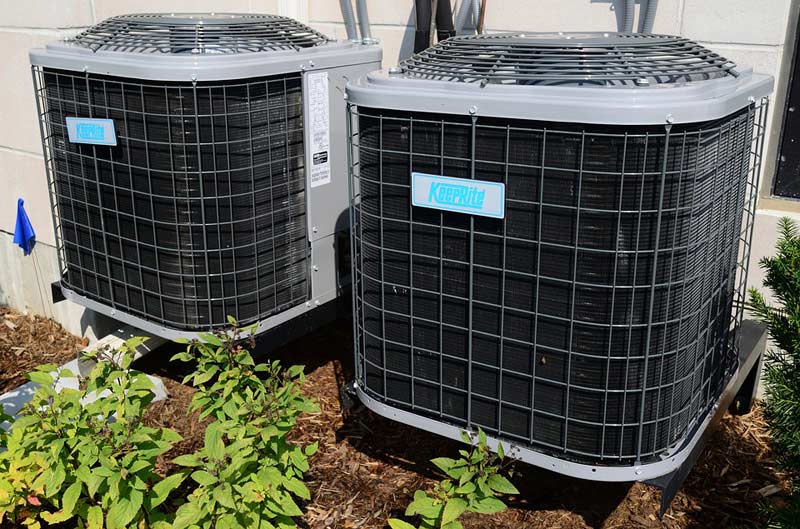
HVAC units from Keeprite installed outdoors, surrounded by greenery, highlighting maintenance and replacement services for home air conditioning systems.

Signs That Show Its Time To Replace Your HVAC System

HVAC services are some of the most sought after services when it comes to home maintenance. Air conditioning is a big investment, but no matter how much you have invested in your HVAC system, a time will come when you will need to replace the system.

It is inevitable because damaged or old HVAC systems will result in poor air quality and increased energy bills. In order to ensure that your HVAC is in good condition, it should undergo maintenance at least two times per years. How do you know that it is time to replace the HVAC system?

Cost of Repairs Start to Add Up

In any working machine, mechanical parts are related to each other in that they are designed to share a similar lifespan. When one part fails, unless it is completely isolated from the rest, the others will not work as expected or might not even work at all. The same applies to the HVAC system.

When some parts start to fail, there is a possibility there may be other problems lurking around the corner. These failures end up becoming inconvenient and the cost of repairs start to increase. This is the first sign that you should replace the entire system.

Age

The lifespan of a typical HVAC unit is 8 to 20 years. The wide range in lifespan is due to several factors such as:

  1. Installation:Was the unit properly installed?
  2. Quality – Different companies offer different qualities. Cheap units often come with cheap parts.
  3. Maintenance – proper maintenance should be done especially to coils, air filtration systems, thermostats, motors, and computer boards among others.

Companies offering HVAC services can help in maintaining your HVAC unit so that it can last longer. If the unit has outlived its lifespan, then it’s high time you should look for a replacement.

Inconsistent Temperature

An old HVAC unit will in most cases have trouble keeping the temperature consistent. There are many reasons why this can happen including cracked ducts, clogged filters, inaccurate thermostat or low fluid levels. This is can be a serious issue if the system is a commercial HVAC meant to serve large buildings with a high number of people.

Opting to keep such a system will cause an increase in energy bills and create an uncomfortable atmosphere in the building. Inconsistencies in temperature may also be as a result of the system not being strong enough to supply air throughout the house or office. It might also be caused by poorly fitted ductwork.

Increased Dust Around The House

HVAC units are not only meant to cool or heat homes, but they are also designed to provide ventilation. When working as required, the system is meant to improve air quality by removing dust as well as controlling air humidity. Therefore, when you notice that the dust around the house has increased, then you should know that the system is no longer working efficiently in filtering the dust from the air.

Unusual Sounds

A HVAC unit is supposed to operate quietly. Just like any other piece of machine, as time goes on, the components become older and you might notice unusual sounds such as squealing and grinding coming from the system. You can call companies which offer HVAC services to come and check it out. They may advise you on the best way to move forward, either repairing the system or replacing the unit.

Reliability

If your system has undergone repairs several times in the last couple of years, know that its reliability has declined and may require a complete replacement. Even if the system is always fixed after it fails, the cost of those repairs will keep on pilling and eventually, it might become more expensive than buying a new unit.

You should trust the experience of your contractor or a maintenance man and follow their guidance. After completing every HVAC services in your house, the contractor should let you know the overall performance of your unit including whether it’s just one component failing or the entire system? A good contractor should explain the problem in a way that you understand and share the reasons for their recommendations.

HVAC components including ductwork, vents, and fittings on a wooden surface, related to air conditioning maintenance and service.

3 Things To Think About Before Skipping Your HVAC’s Yearly Routine Maintenance

When it comes to comfort, HVAC systems play a major role. From commercial HVAC systems to residential, the units are responsible for keeping everyone cool in the summer and warm in the winter; its physical health is integral to how well it performs those jobs.

Naturally, the best way to keep your unit in tip-top shape is to have it inspected at least once a year (or twice a year for efficient HVAC systems). Unfortunately, many home and business owners only see the price tag associated with each visit; before you go skipping your unit’s routine maintenance or commercial service, consider these three things.

  • What is your risk tolerance? By choosing to defer HVAC maintenance, you are taking a risk. If the risk is worth it depends on your understanding of a worst-case scenario: for example, if your AC fails during a 100-degree heat wave and you own heat-sensitive electronic equipment, you’ll be facing more than just discomfort. By its very nature, routine maintenance mitigates risk, so you need to decide if the cost of a commercial service check is comparable to what you may lose if something goes wrong.
  • You may not be saving money. The main reason people bypass routine HVAC maintenance is to save themselves the bill. Though this may make sense at the time, it may actually end up costing you. Beyond the likelihood that a maintenance check will uncover a problem that may prove expensive if left unfixed, technicians also boost the efficiency of your machine when they visit. This results in lower monthly energy bills by increasing operating capacity; the cost of the visit may be paid multiple times over in the lack of this efficiency.
  • The longer you wait, the shorter your unit’s lifespan. Well-made HVAC systems should last between 10-20 years, but that time frame is dependent on how well it’s cared for. When maintenance fails to be performed, the unit may run at higher temperatures or pressures which causes additional wear-and-tear. If this goes unchecked for too long, its components will fail prematurely and you’ll be facing an even heftier bill to replace it.

In the grand scheme of things, it always pays to prevent. The costs associated with picking up the pieces of a broken HVAC — which includes time as much as money — are obscene compared to the work required to schedule a routine commercial service or maintenance appointment. In short, HVAC system maintenance is worth the call. Always.

Three HVAC units installed outside a residential building, surrounded by plants and a well-maintained lawn, illustrating home climate control solutions.

The Intricacies of HVAC: 3 FAQs About Your Home’s HVAC System

You may have mastered the basics of home maintenance, like keeping an eye on the plumbing and knowing when to call an electrical contractor, but maintaining an HVAC system can seem like a mystery. As an often hidden puzzle of parts and pieces, you’re bound to have questions on this complicated system.

What does HVAC stand for and what does it do for my home?

HVAC is short for heating, ventilation, and air conditioning, and those are the main functions of the system. It provides an acceptable air quality inside your home by diluting it and removing any contaminants. While a building can function with natural ventilation, in theory, it requires knowing the many differences in air pressure that exist within and outside of a building to create an effective airflow. The HVAC system was developed as mechanical ventilation because it is controllable and manipulates the natural air flow.

How exactly does an HVAC system work?

In general, an HVAC system draws in outside air through its air handling unit. The air then goes through a filtration system to remove matter such as mold, allergens, and dust. Next, the air is heated or cooled according to the HVAC’s settings for the time of year, and then it is circulated throughout the building via a system of supply ducts and registers. As a final step, a portion of air from the inside is expelled from the building through the air handling unit or a stand-alone exhaust unit.

Are there different kinds of HVAC systems?

Yes, there are several different HVAC systems that are suited for different kinds of homes.


  • Communicating Systems. This convenient and efficient HVAC system communicates when to use either the heat or air system. It detects what your home needs and will suggest what to use accordingly.


  • Ductless Systems. For older homes without air ducts, this HVAC system is built into alternative spaces within the home. The outdoor unit is connected to an indoor unit that is mounted on a wall or ceiling.


  • Geothermal Systems. This earth-conscious system regulates your home’s indoor environment according to steady temperatures underground. This HVAC system uses less energy, lowers energy costs, and reduces your carbon footprint.


  • Packaged Systems. All of the needed heating and cooling systems are contained in a one-cabinet system for those with limited space. Although it sounds more compact, it can even contain heat pump systems if a home requires it.


  • Split Systems. In this design, the HVAC system is placed both inside and outside of your home. This is also space friendly as it allows for more room inside of your home.

For the best air quality and optimal comfort in your home, you should schedule a maintenance inspection for your HVAC system twice a year. As the regulator of your interior life’s comfort, it is worth a call. Always.

HVAC technician repairing air conditioning unit outdoors, focusing on electrical connections and maintenance, relevant to home cooling solutions.

Tell-Tale Signs Your Air Conditioner Should Be Trashed

Now that summer has officially reared its iron-hot head, it’s time to rev up your old air conditioner and pretend it isn’t 90 degrees Fahrenheit outside. Unfortunately, you quickly notice your old air conditioner just isn’t working like it used to. Here are some of the tell-tale signs you need to invest in a new HVAC system.

It’s old
The usual air conditioner, whether they’re window mounted or a part of your central air system, are only built to last around 10 to 15 years. While you might be able to use it for a little longer, there’s no rule that bars against it sputtering out a little early. If your air conditioner is over a decade old, getting a new air conditioner installed is likely the more affordable option.

HVAC technology is constantly evolving. Anything older than a decade likely doesn’t have the fuel efficiency that newer models boast. While you might be able to repair your air conditioner by calling a reliable HVAC system technician near you, asking them about current models and promotions will be a better upgrade.

This isn’t its first repair
If your air conditioner has been repaired multiple times before, it’s more likely that the machine will keep breaking down. While it’s recommended your HVAC system should get inspected twice a year to ensure it’s working properly, you shouldn’t have to get it repaired each time it gets inspected. Purchasing a new air conditioner will cost you less in the long run than having to pay for near-constant repairs.

It uses R 22 Freon
Freon is an aerosol propellant that’s used in air conditioners to make the air colder. This propellant is actually being phased out because of concerns regarding energy efficiency. Not only are new refrigeration technologies better for your home and environment, but it will help you avoid costly repairs to your HVAC unit. New units use R-401a.

It simply isn’t doing its job
Air conditioners are built to make the air around you cooler; if your air conditioner fails to make the heat bearable, it might be time to look into repair technicians near you or simply replace your HVAC system with something more efficient. Inefficient air conditioners will not only keep you hot and muggy, but they’ll raise your electricity bill considerably.

Luckily, purchasing a new commercial HVAC system will solve any summer-induced sweating. Call your local HVAC expert at The Bosworth Company today to get an estimate on the cost of repairing or replacing your old air conditioner. Worth the Call. Always.

Cold weather readiness graphic featuring frosted pine branches and text asking, "Is your home cold weather ready?" with Bosworth Company branding.

Is Your Home Cold Weather Ready?

Though we’re experiencing unseasonably warm weather for fall, it’s never too early to get your home cold weather ready. In fact, we’re expecting a 30° temperature drop mid-week! The Bosworth Company prefers preparedness over panic, so be sure to follow these steps on getting ready for chilly winter temperatures.

Get Your Home Cold Weather Ready with These 4 Tips

Prep the Plumbing

Though many people expect cold weather problems to come from their furnace, they often forget about frozen pipes! It’s important to get your plumbing ready for cooler temperatures, including sealing off outdoor valves and insulating exposed pipes. Not only can these freeze when the temps drop, you also risk them bursting when water expands.

Seal the Deal

Prevent cold air from entering your home by sealing drafty windows and doors. As your home settles with age or seals begin to wear, your home may not be as protected from air leaks as you’d like. Additionally, keep your garage above North Pole temperatures by installing weather stripping along the garage floor.

Invest in a Nest®

Have you heard about the Nest WiFi Thermostat offered by Bosworth? It’s a high-tech way to save on your energy bills each month. With the Nest, you’re able to take control of your thermostat, no matter where you are! Not only does it help keep your home toasty warm, on average, the Nest saves consumers between 10% and 12% on their monthly heating bills.

Prepare, Prepare Prepare

“By failing to prepare, you are preparing to fail.” -Benjamin Franklin

Maintaining your home is critical – and we aren’t just talking about cosmetic improvements. When you include our fall electrical and heating services as part of your home maintenance plan, it can help you avoid a catastrophic event when it starts to really get cold. You should also consider adding a Kohler backup generator to your home, if you’re worried about electrical outages this winter.

Are you worried your home isn’t going to pass the cold weather test? Don’t fear – Bosworth is here! Whether you need plumbing, heater, or electrical service for your home or business, we’re available to help. Schedule your service today!

HVAC system components with text overlay "How To Choose An HVAC System" and "BOSWORTH" logo, relevant to heating and cooling services in Kerrville, Texas.

How To Choose An HVAC System

[et_pb_section fb_built=”1″ admin_label=”section” _builder_version=”3.0.47″][et_pb_row admin_label=”row” _builder_version=”3.0.47″ background_size=”initial” background_position=”top_left” background_repeat=”repeat”][et_pb_column type=”4_4″ _builder_version=”3.0.47″ parallax=”off” parallax_method=”on”][et_pb_text admin_label=”Text” _builder_version=”3.0.47″ background_size=”initial” background_position=”top_left” background_repeat=”repeat”]

To choose an HVAC system in Kerrville Texas, it seems like you have to be a professional. There are so many terms, ratings and features…how is the average person supposed to know which system to choose? Don’t worry, we’re here to help! Let us tell you more about how to choose an HVAC system.

Size

As a rule of thumb, air conditioners with a 15,000 BTU rating should be able to cool rooms up to approximately 875 sq. ft. HVAC systems are sized according to their cooling capacity (which are expressed in BTU per hour), so your first consideration is to match the air conditioner to the room you want to cool. If the unit is too large, it will cool the space so quickly that the thermostat will shut the unit down without lowering the humidity level. If the unit is too small, it will overwork, but won’t cool the space.

Cooling Capacity

Cooling capacity is dependent upon square footage, windows, sun exposure, insulation, room use, etc. You can use a simple air conditioning calculator available from The Association of Home Appliance Manufacturers to determine the cooling capacity of your space. Most units you’ll see in stores compare the square footage of the room to BTU capacity.

Controls

Control options are important when shopping for an air conditioner. Look for multi speed fans and adjustable thermostats. Both of these will help you achieve maximum comfort and switch to lower settings for a quieter operation. More precise control is offered by digital controls, with features such as preset scheduling and timers to control certain temperatures at certain times. This feature can ultimately save you money and your unit efficiency!

Filters

During the peak cooling season, your AC filter should be replaced every 3-4 weeks. For this reason, you should check the AC units you’re shopping for to see how easy (or hard) it is to replace the filter. If it is hard for you to reach or replace, the less likely you are to do it. Try to find one that simply slides up and down without any screws or other fasteners.

Efficiency

Last, but certainly not least, consider efficiency. Manufacturers are required to list the energy rating directly on the unit, making an easy determination of energy efficiency. The EER, or Energy Efficiency Ratio, is the cooling capacity divided by the electrical power required to run the unit. The higher the number, the better. Any unit with an EER above 10 is extremely efficient. Of course, with a higher EER also comes a higher price tag. Keep an eye out for the Energy Star logo. Energy Star products are certified to be 15% more efficient than those meeting the minimum federal requirements.

Save $1600

As Dave Lennox Premier Dealers, we have access to the best Lennox promotions available, and are able to offer our customers significant savings on a qualifying system. Currently, you can save up to $1600 on a Lennox system from now until November 17, 2017. Learn more here or contact us today!

[/et_pb_text][/et_pb_column][/et_pb_row][/et_pb_section]

Puzzle pieces with letters "H", "V", "A", "C" illustrating HVAC concepts for The Bosworth Company's educational article.

Decoding HVAC Acronyms

If you’ve ever purchased an air conditioner, or even thought about purchasing an air conditioner, we’re sure you’ve run across some unfamiliar acronyms. Today, we’re clearing up the confusion by decoding some common HVAC acronyms! Take a look!

HVAC Acronyms

AHU – Air Handling Unit
The air handling unit is the central unit consisting of fan(s), heating and cooling elements, filter racks or chamber, dampers, humidifier, and other central equipment required to provide adequate ventilation and extract.

EER – Energy Efficiency Ratio

A unit’s EER can help you to determine how effective the appliance’s energy output is based on certain criteria. In fact, EnergyStar ratings are based on energy efficiency.

HERS  – Home Energy Rating System

Created to establish a benchmark to determine how energy efficient a home is in relation to others. The HERS Index is based off a newly constructed home being scored at 100. The closer the number to 100, the less efficient the property is. The further the number from 100, the more energy efficient. Just like we’re back in school!

HVAC – Heating, Ventilation, And Air Conditioning

Of course, we can’t forget HVAC! An HVAC, or a heating, ventilation and air conditioning system is used to provide heating and cooling services from a unit.

MERV – Minimum Efficiency Reporting Value

These values range from 1-20: 1 is an average filter for a window air conditioner and 20 is the filtration system for medical or manufacturing cleanrooms. Most residential air conditioners use filters rated between 8 and 12. Put simply, MERV is the effectiveness of how well your filter is at removing particulates from the air.

Contact Us Today!

We’re hoping the terms above will help in your AC research so that you can make the best decision for your next air conditioner! If you’d like to know more about choosing an air conditioner, contact us today. In fact, we have an AC promotion coming up that we know you’ll be interested in!

Sunset image with text overlay asking, "Is it time to replace your thermostat?" highlighting the importance of thermostat maintenance and replacement in home HVAC systems.

Is It Time To Replace Your Thermostat?

Quite often, a thermostat gives you some clues that it’s time for replacement. Find out what these clues are to know if it’s time to replace your thermostat!

No Power/Unresponsive

One of the telltale signs that a thermostat is due for replacement is when adjusting the temperature lever produces no change in home temperature. Another sign is an unresponsive interface or unlit display light.

Changing the Batteries Did Not Help

Of course, the first response to an unresponsive thermostat may be to change the batteries. While this may sometimes fix the problem, you may not always be that lucky. If the thermostat is still unresponsive after changing the batteries, it may be too late for a quick fix or simple repair.

HVAC Runs Continually Or Not At All

This could be due to a wiring defect that causes the thermostat to lose its connection to the home’s heating and cooling system may be the issue. It  could also be reading temperatures incorrectly and not turning heating or cooling on when needed. This same defect could also cause the HVAC to not start at all.

Different Temperatures Throughout

If you’ve noticed different temperatures throughout your home, this could be a sign it’s time to replace your thermostat. Shifts in temperature occur when a thermostat switches the HVAC system on and off when it is not supposed to, causing rooms that are furthest from the central unit not receiving an even distribution of the desired temperature for the home.

Nest Thermostat
Want The Best? Go With Nest!

Time To Call The Bosworth Company!

If your thermostat is showing any of the above signs, it could be time to call The Bosworth Company. Our expert HVAC technicians will diagnose the problem and provide the best solution for you. If it is time for a thermostat upgrade, you should consider a Nest Wifi Thermostat. Nest learns the patterns of your home and adjusts accordingly…all from the palm of your hand! Learn more about Nest and our current promotion here.

Nest thermostat showcasing cooling temperature setting with smartphone app displaying home control features, emphasizing energy efficiency and smart technology benefits.

3 Reasons You Need A Nest Thermostat

While there are a lot of ways to keep your HVAC unit working efficiently and control your energy costs, very few will be as effective as a smart thermostat. However, it’s important to know that you’re getting the best option available. At The Bosworth Company, we pride ourselves on providing only the best to our customers, which is why we are a Pro Contractor for the Nest Thermostat. Check out a few of the benefits you can enjoy when you decide it’s time to upgrade your system.

#1: Nest is self-learning

Did you know Nest was co-founded by Apple engineers? That means they’ve taken thermostats to the next level. The self-learning capabilities save you time and effort when setting comfortable temperatures.

The first week, your Nest Thermostat learns your routine, as well as what temperatures you find comfortable and when. From there, it designs a custom schedule and programs itself to heat and cool your home, taking into account the unique features of your home.

#2: Energy savings are proven

We’re sure you’ve heard that you can save energy with a programmable thermostat, but have you seen the proven data to back it up? Nest provides the data and has shown to save an average of between 10-15% on your heating and cooling bill per year. In fact, most people find that the savings pay for the thermostat in two years or less.

#3: You can adjust from anywhere

These days, everything is at our fingertips. Controlling your Nest Thermostat is no exception. You can adjust your thermostat from anywhere you can use a mobile device. Any time you want to adjust your settings or check the current temperature of your home, you can!

Contact Us Today!

Are you ready to make the most of your HVAC system with a Nest Thermostat? Contact the experts at The Bosworth Company for a professional installation! In fact, we are currently offering an irresistible bundle – get a system clean and check, installation of a Nest Thermostat and 5 year warranty (2 year warranty when it’s self-installed), all for $470! Want to know more? Contact us today!